

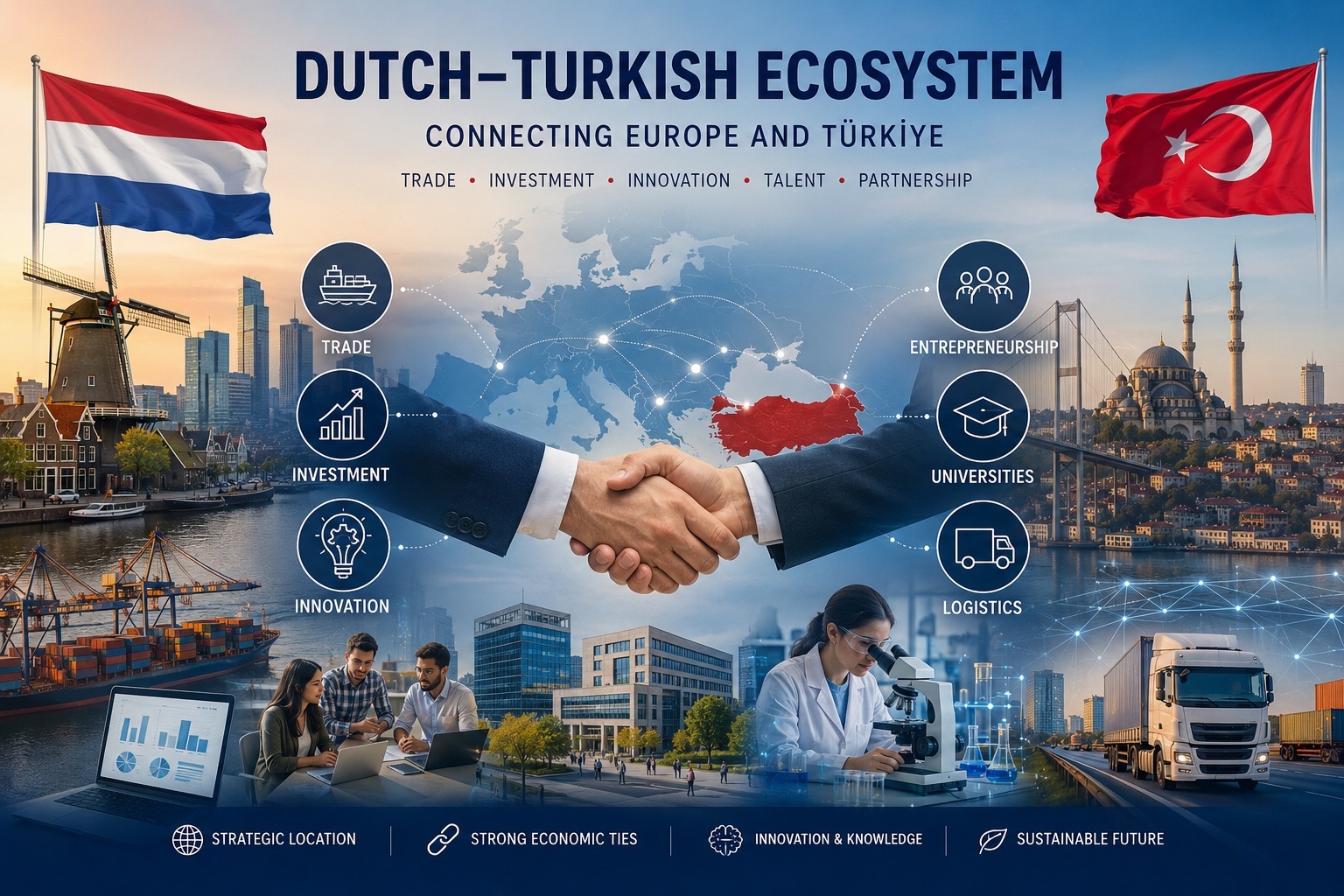
For decades, the relationship between the Netherlands and Türkiye has largely been viewed through the lens of migration history, integration, and cultural ties. Yet beneath that social and historical layer, another reality quietly emerged: a deeply interconnected economic ecosystem linking entrepreneurs, companies, universities, investors, logistics networks, and innovation actors across both countries.
Today, the Dutch–Turkish relationship is no longer simply bilateral. It increasingly functions as a strategic corridor between Northwestern Europe and Türkiye — connecting trade, manufacturing, logistics, technology, talent, and investment flows.
This ecosystem did not emerge overnight. It developed gradually through migration, entrepreneurship, trade expansion, industrial cooperation, and the growing internationalization of both economies.
What was once largely informal and community-driven has evolved into a complex cross-border ecosystem with growing strategic importance for Europe, Türkiye, and the Dutch–Turkish business community itself.
From Migration to Economic Connectivity
The foundations of the Dutch–Turkish ecosystem were laid during the labor migration agreements of the 1960s. Thousands of Turkish workers came to the Netherlands to support the rapidly growing Dutch economy.
Over time, those temporary migration flows evolved into permanent communities.
Alongside this social development, entrepreneurship emerged as a defining characteristic of the Turkish community in the Netherlands. Small family businesses gradually evolved into broader business networks operating across sectors such as:
- logistics,
- retail,
- construction,
- manufacturing,
- food,
- hospitality,
- healthcare,
- trade,
- technology,
- and professional services.
Today, entrepreneurs with Turkish roots form one of the most active entrepreneurial communities in the Netherlands.
According to the Turkish Ministry of Foreign Affairs, approximately 23,000 companies founded by entrepreneurs of Turkish origin operate in the Netherlands, employing around 80,000 people with an estimated annual turnover of approximately €8 billion.
What started as community-based entrepreneurship has increasingly become part of a larger transnational economic network connecting the Netherlands and Türkiye.
A Strong and Expanding Trade Relationship
Trade relations between the Netherlands and Türkiye have steadily intensified over the years.
According to official Turkish government figures, bilateral trade volume reached approximately $13.6 billion in 2024, while more recent estimates indicate trade volume approaching $14 billion.
Türkiye exports a wide range of products to the Netherlands, including:
- automotive products,
- textiles,
- machinery,
- chemicals,
- food products,
- and industrial components.
At the same time, the Netherlands exports:
- industrial equipment,
- chemicals,
- agricultural technologies,
- machinery,
- and advanced industrial inputs to Türkiye.
The Netherlands also functions as a strategic European gateway for Turkish exports through infrastructure such as:
- the Port of Rotterdam,
- Schiphol Airport,
- and the broader Dutch logistics ecosystem.
Increasingly, the trade relationship is not only about import and export, but also about supply chains, regional production networks, and European market access.
One of Türkiye’s Largest Foreign Investors
Beyond trade, investment relations between both countries are substantial.
The Netherlands has consistently been among the largest foreign investors in Türkiye.
According to recent figures, Dutch companies have invested approximately $34 billion in Türkiye since 2002.
More than 3,000 Dutch-origin companies are active in Türkiye across sectors such as:
- manufacturing,
- logistics,
- energy,
- food,
- chemicals,
- finance,
- agriculture,
- and technology.
At the same time, Turkish investments into the Netherlands have also grown significantly, reaching nearly $20 billion over the same period.
This increasingly two-directional investment relationship reflects a broader strategic reality:
- Dutch companies see Türkiye as a manufacturing and regional operations hub.
- Turkish companies increasingly use the Netherlands as an entry point into European markets.
The Entrepreneurial Ecosystem as a Bridge
One of the defining features of the Dutch–Turkish ecosystem is the role of diaspora entrepreneurship.
Business relationships between the Netherlands and Türkiye are often strengthened through:
- family ties,
- bilingual and bicultural professionals,
- community trust networks,
- and entrepreneurs operating across both countries simultaneously.
This creates a unique business ecosystem that combines:
- local integration,
- international connectivity,
- cultural understanding,
- and commercial flexibility.
Organizations such as:
- HOTIAD,
- MÜSİAD Nederland,
- TOV Nederland,
- and the Dutch Business Association Turkey
have contributed to strengthening these economic and professional networks over the years.
Yet despite its size and economic importance, the ecosystem itself often remains fragmented and insufficiently visible.
Many connections still depend heavily on:
- personal networks,
- informal referrals,
- WhatsApp groups,
- LinkedIn outreach,
- and isolated organizational circles.
As the ecosystem continues to mature, the need for more structured visibility, discoverability, and ecosystem mapping is becoming increasingly clear.
Universities and Knowledge Networks
Another important — but often overlooked — component of the Dutch–Turkish ecosystem is the academic and innovation layer.
For decades, Dutch universities such as:
- Delft University of Technology,
- Erasmus University Rotterdam,
- Wageningen University & Research,
- and Eindhoven University of Technology
have attracted Turkish students, researchers, engineers, and entrepreneurs.
At the same time, Turkish universities such as:
- Middle East Technical University,
- Boğaziçi University,
- Koç University,
- Sabancı University,
- and Istanbul Technical University
have increasingly integrated into international research and innovation ecosystems.
Cooperation increasingly takes place around:
- sustainability,
- AI,
- engineering,
- advanced materials,
- agriculture,
- healthcare,
- logistics,
- digitalization,
- and energy transition.
This knowledge layer may become one of the most strategically important dimensions of the Dutch–Turkish ecosystem in the coming decade.
Why the Ecosystem Matters Strategically
The growing importance of the Dutch–Turkish ecosystem is closely linked to broader global developments.
Europe is increasingly confronted with:
- supply chain restructuring,
- geopolitical fragmentation,
- energy transition,
- digital transformation,
- manufacturing resilience,
- and the need for regional industrial partnerships.
Türkiye offers:
- industrial scale,
- manufacturing capacity,
- strategic geographic positioning,
- a relatively young workforce,
- and strong regional connectivity.
The Netherlands offers:
- European market access,
- world-class logistics infrastructure,
- financial and legal ecosystems,
- innovation networks,
- and global trade connectivity.
Together, they form a complementary economic relationship with growing strategic potential.
A New Phase Is Emerging
For many years, the Dutch–Turkish ecosystem evolved organically.
Today, a new phase appears to be emerging:
- more international,
- more innovation-driven,
- more professionalized,
- and increasingly ecosystem-oriented.
The key challenge ahead is no longer whether the ecosystem exists.
The real challenge is whether it can become:
- more visible,
- more connected,
- more collaborative,
- and more strategically organized.
As global economic dynamics continue to shift, the Dutch–Turkish corridor may become increasingly important — not only for entrepreneurs and companies, but also for innovation ecosystems, universities, investors, and future European economic cooperation.
Sources & References
- Turkish Ministry of Foreign Affairs — Commercial and Economic Relations Between Türkiye and the Netherlands
- https://www.mfa.gov.tr/commercial-and-economic-relations-between-turkiye-and-the-netherlands.en.mfa
- Anadolu Agency — Dutch firms have invested $34B in Türkiye since 2002
- https://www.aa.com.tr/en/economy/dutch-firms-have-invested-34b-in-turkiye-since-2002/3859668
- Netherlands & You — Economy and Trade in Türkiye
- https://www.netherlandsandyou.nl/web/turkiye/themes/economy-and-trade
- DBA Turkey — Facts & Figures
- https://www.dbaturkey.org/facts-figures/