

For decades, trade between the Netherlands and Türkiye has steadily expanded. What once centered largely around labor migration and small-scale commerce has evolved into a substantial bilateral economic relationship connecting logistics, manufacturing, agriculture, industry, retail, technology, and international supply chains.
Today, the trade relationship between both countries extends far beyond simple import and export statistics. Increasingly, it forms part of a broader strategic economic corridor linking Türkiye’s industrial capacity and regional positioning with the Netherlands’ role as Europe’s logistics and trade gateway.
As global supply chains continue to shift and Europe searches for greater industrial resilience, the Dutch–Turkish trade relationship is becoming increasingly relevant.
A Trade Relationship Worth Billions
Trade between the Netherlands and Türkiye has grown consistently over the past decades.
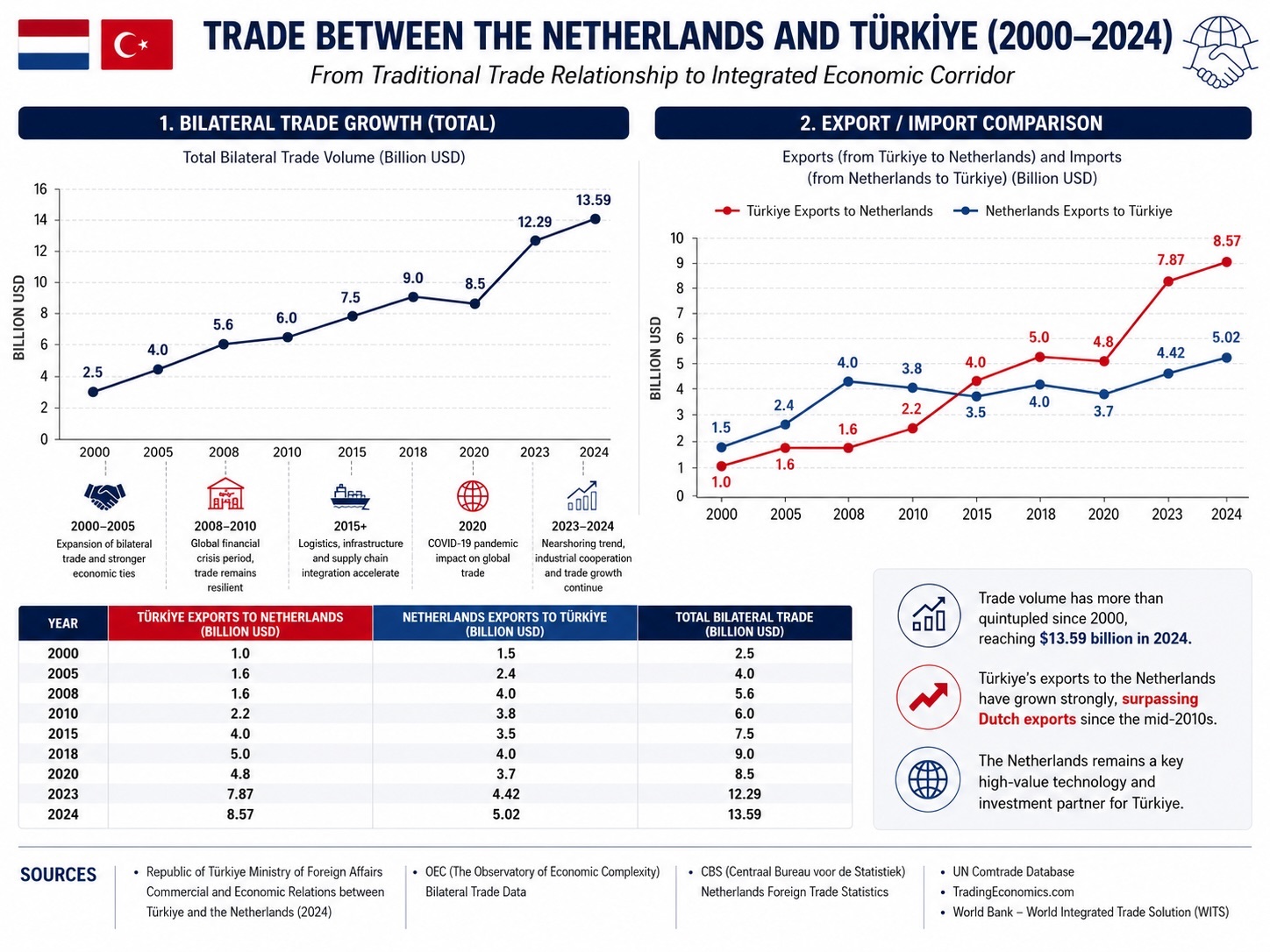
According to the Turkish Ministry of Foreign Affairs, bilateral trade volume reached approximately $13.59 billion in 2024, up from approximately $12.29 billion in 2023. Türkiye exported around $8.57 billion worth of goods to the Netherlands, while imports from the Netherlands reached approximately $5.02 billion.
What is particularly striking is how the relationship evolved structurally over time. In the early 2000s, Dutch exports to Türkiye were significantly larger. Today, Türkiye exports substantially more to the Netherlands — reflecting the industrial maturation of Türkiye and its growing integration into European supply chains.
As illustrated in the accompanying trade overview, bilateral trade between both countries has more than quintupled since 2000. The data also shows how the Dutch–Turkish relationship evolved from a relatively traditional import-export structure into a far more integrated industrial and logistics partnership.
Trade figures and visualizations are based on data from the Turkish Ministry of Foreign Affairs, OEC, CBS, UN Comtrade, World Bank WITS, and TradingEconomics.
Türkiye’s Exports to the Netherlands
Türkiye exports a highly diversified portfolio of products to the Netherlands.
Key export categories include:
- automotive products and components,
- textiles and apparel,
- machinery,
- electronics,
- chemicals,
- food and agricultural products,
- construction materials,
- and industrial equipment.
The Netherlands is particularly important because it functions not only as a consumer market, but also as a redistribution hub into wider Europe.
A significant portion of Turkish goods entering the Netherlands eventually continues toward:
- Germany,
- Belgium,
- France,
- Scandinavia,
- and other European markets.
This makes Dutch infrastructure strategically important for Turkish exporters.
Rotterdam: Türkiye’s Gateway Into Europe
The Port of Rotterdam plays a central role in the Dutch–Turkish trade corridor.
As Europe’s largest port, Rotterdam functions as:
- a logistics hub,
- a distribution center,
- and a strategic access point into the European single market.
Turkish exporters benefit from:
- advanced logistics infrastructure,
- customs efficiency,
- multimodal transport networks,
- warehousing ecosystems,
- and access to European consumers and industries.
For many Turkish companies, entering the Netherlands effectively means entering Europe.
At the same time, Dutch logistics companies increasingly use Türkiye as a regional production and distribution base connecting Europe, the Middle East, Central Asia, and North Africa.
Dutch Exports to Türkiye
The Netherlands exports high-value industrial and technological products to Türkiye.
These include:
- machinery,
- chemicals,
- industrial systems,
- agricultural technologies,
- greenhouse solutions,
- logistics technologies,
- energy-related systems,
- and advanced production equipment.
Dutch expertise is especially visible in:
- agriculture,
- water management,
- logistics,
- sustainability,
- and industrial innovation.
Türkiye’s rapidly developing industrial sector increasingly requires:
- advanced machinery,
- automation,
- supply chain optimization,
- sustainability technologies,
- and digital transformation solutions.
This creates growing opportunities for Dutch companies.
Trade Is Becoming More Strategic
The Dutch–Turkish trade relationship is evolving under the influence of major global developments.
Europe increasingly faces challenges related to:
- geopolitical tensions,
- supply chain disruptions,
- industrial competitiveness,
- energy transition,
- and strategic autonomy.
As a result, companies are reconsidering how and where they manufacture products.
Türkiye is becoming increasingly attractive because of:
- its strong industrial base,
- manufacturing capabilities,
- customs union access with the EU,
- relatively competitive production costs,
- and strategic geographic location.
At the same time, the Netherlands remains one of Europe’s strongest gateways for:
- trade,
- finance,
- logistics,
- innovation,
- and international business operations.
This combination creates natural economic complementarity.
Beyond Trade Numbers: The Supply Chain Dimension
Perhaps the most important shift is that Dutch–Turkish trade is increasingly integrated into broader European supply chains.
Rather than isolated exports, many sectors now operate through:
- cross-border production chains,
- industrial partnerships,
- regional sourcing strategies,
- and integrated logistics systems.
This is particularly visible in sectors such as:
- automotive,
- manufacturing,
- chemicals,
- textiles,
- electronics,
- food processing,
- and machinery.
As European industries seek alternatives to long-distance supply chains, Türkiye’s role as a nearshoring and regional manufacturing hub is likely to grow further.
The Human Layer Behind the Trade Relationship
An often underestimated factor behind the strength of Dutch–Turkish trade relations is the human network connecting both countries.
The Turkish-Dutch entrepreneurial ecosystem contributes significantly through:
- bilingual professionals,
- bicultural entrepreneurs,
- diaspora business networks,
- family-owned trading structures,
- and long-standing trust relationships.
This human infrastructure lowers barriers for:
- business development,
- market entry,
- partnerships,
- and commercial cooperation.
It also creates flexibility and resilience that purely institutional trade relationships often lack.
Challenges Still Exist
Despite the strong trade relationship, structural challenges remain.
These include:
- fragmented business visibility,
- limited ecosystem coordination,
- regulatory complexity,
- insufficient strategic matchmaking,
- and overreliance on informal networks.
Many companies still struggle to identify:
- reliable partners,
- sector specialists,
- investors,
- distributors,
- or innovation collaborators across both countries.
As the ecosystem grows more sophisticated, the demand for better visibility, discoverability, and ecosystem intelligence will likely increase.
A Corridor With Strategic Potential
Trade between the Netherlands and Türkiye is no longer simply a bilateral exchange relationship.
Increasingly, it represents:
- a logistics corridor,
- an industrial partnership,
- an innovation opportunity,
- and a bridge between European and regional markets.
As global economic dynamics continue to shift, the Dutch–Turkish trade corridor may become increasingly important for:
- manufacturing resilience,
- supply chain diversification,
- sustainability transitions,
- and future European industrial strategy.
The challenge ahead is not whether trade will continue growing.
The real question is whether the broader ecosystem surrounding that trade can become more connected, visible, and strategically organized.
Sources & References
- Turkish Ministry of Foreign Affairs — Commercial and Economic Relations Between Türkiye and the Netherlands
- https://www.mfa.gov.tr/commercial-and-economic-relations-between-turkiye-and-the-netherlands.en.mfa
- OEC — Observatory of Economic Complexity
- https://oec.world/en/profile/bilateral-country/nld/partner/tur
- CBS — Netherlands Foreign Trade Statistics
- https://www.cbs.nl
- UN Comtrade Database
- https://comtradeplus.un.org
- TradingEconomics — Netherlands Exports to Turkey
- https://tradingeconomics.com/netherlands/exports/turkey
- TradingEconomics — Turkey Exports to Netherlands
- https://tradingeconomics.com/turkey/exports/netherlands
- World Bank WITS Trade Database
- https://wits.worldbank.org